

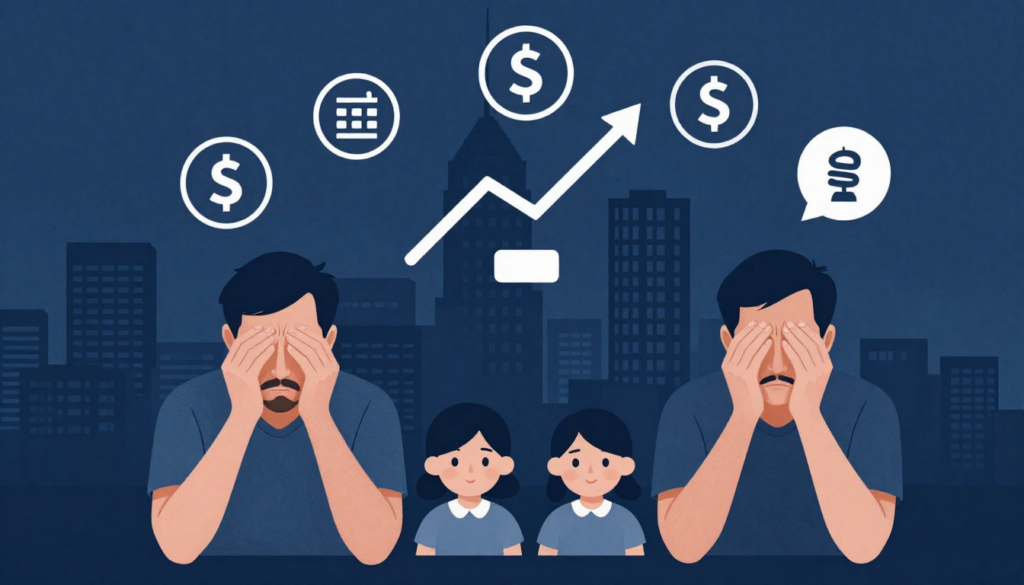
Middle Class Under Pressure: 7 Harsh Reasons Why Stability Feels Impossible in 2026
Opinion • Economy • Social Reality
- The Middle Class Reality in 2026
- Why Official Data Feels Disconnected
- Reason 1: Housing Costs Stay Structurally High
- Reason 2: Healthcare Expenses Keep Compounding
- Reason 3: Education and Skill Inflation
- Reason 4: Income Growth Has Stalled
- Reason 5: Job Security Is Weaker Than It Appears
- Reason 6: Debt Has Become Permanent
- Reason 7: Safety Nets Are Thinning
- Final Perspective
Middle class households are under pressure in 2026, even though inflation headlines suggest stability.
This disconnect is not psychological.
It reflects structural changes in costs, income, and risk that are reshaping everyday financial life.
The Middle Class Reality in 2026
For decades, the middle class represented stability.
Predictable income, rising living standards, and gradual asset building defined the experience.
That model is weakening.
Why Official Data Feels Disconnected
Inflation measures the rate of price increase, not the absolute cost of living.
Prices can stabilize at high levels, locking households into permanently higher expenses.
For the middle class, this feels like constant pressure despite “stable” data.
Reason 1: Housing Costs Stay Structurally High
Housing is the largest burden on middle-class budgets.
Limited supply, zoning constraints, and slow construction cycles keep prices elevated.
Even rate relief has not restored affordability.
Reason 2: Healthcare Expenses Keep Compounding
Healthcare costs rarely move downward.
Insurance premiums, diagnostics, and out-of-pocket expenses rise year after year.
This silently erodes disposable income.
Reason 3: Education and Skill Inflation
Education is no longer optional.
Degrees, certifications, and continuous reskilling are required to maintain income relevance.
This creates permanent financial commitments for families.
Reason 4: Income Growth Has Stalled
Wage growth has not matched core expense growth.
In many sectors, real income remains flat.
The result is effort without proportional improvement in stability.
Reason 5: Job Security Is Weaker Than It Appears
Employment looks stable on the surface.
Automation, restructuring, and contract-based roles increase uncertainty underneath.
Middle-class households respond by becoming defensive.
Reason 6: Debt Has Become Permanent
Debt now fills the gap between income and expenses.
Mortgages, education loans, and revolving credit reduce flexibility.
Servicing costs persist regardless of inflation trends.
Reason 7: Safety Nets Are Thinning
Corporate and public safety nets have weakened.
Benefits are conditional, coverage is limited, and personal buffers matter more than before.
This shifts more risk onto the middle class.
Analysis summarized by Investopedia explains why middle-class vulnerability increases when structural costs rise.
A related breakdown on household resilience is discussed here.
Stable inflation does not mean stable lives.
Final Perspective
The pressure on the middle class is not temporary.
It reflects long-term structural shifts in costs, income, and risk.
In 2026, financial stability depends less on macro indicators and more on household resilience.
Those who adapt systems early handle uncertainty better than those waiting for relief.
Disclaimer: This content is for educational purposes only and does not constitute financial or investment advice.