
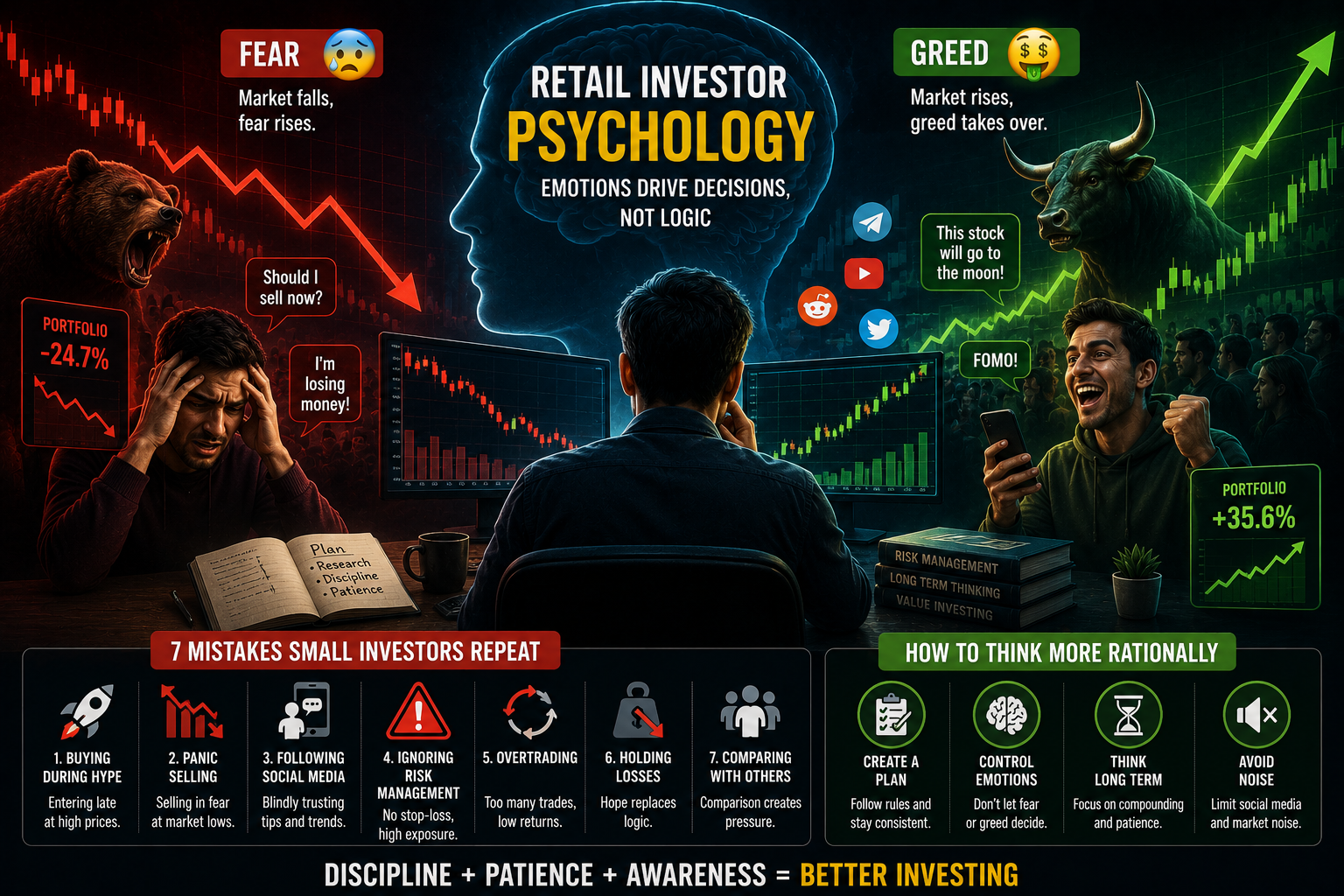
Retail Investor Psychology: 7 Mistakes Small Investors Repeat During Market Trends
Stock markets are driven not only by numbers, but also by emotions.
This is where retail investor psychology becomes important. Small investors often react emotionally during market rallies, crashes and trending sectors.
Fear, greed and social media hype quietly influence decision making more than most people realize.
Table of Contents
- What Is Retail Investor Psychology
- Why Emotions Affect Investing
- 7 Common Investor Mistakes
- How to Think More Rationally
- Final Thoughts
What Is Retail Investor Psychology
Retail investor psychology refers to the emotional and behavioral patterns shown by individual investors while making market decisions.
Unlike institutions, retail investors often react faster to news, fear and market trends.
Why Emotions Affect Investing
Markets create uncertainty, and uncertainty creates emotional reactions.
- Fear during market crashes
- Greed during rallies
- FOMO during trending stocks
These emotions often lead to irrational decisions.
7 Mistakes Small Investors Repeat
1. Buying During Hype
Many investors enter after large price rallies.
2. Panic Selling
Fear causes selling at the worst possible time.
3. Following Social Media Blindly
Online trends influence decisions emotionally.
4. Ignoring Risk Management
Greed often removes discipline.
5. Overtrading
Too many trades reduce consistency.
6. Holding Losses Emotionally
Hope replaces logic.
7. Comparing With Others
Comparison creates pressure and impatience.
How to Think More Rationally
To improve retail investor psychology:
- Create clear investment rules
- Avoid emotional decisions
- Think long term
- Limit noise from social media
Discipline matters more than excitement.
Final Thoughts
The real challenge in markets is not only analysis — it is emotional control.
Understanding retail investor psychology helps investors make calmer and smarter decisions during volatile markets.
Explore more in our Market section.
Disclaimer: This article is for educational purposes only and should not be considered investment advice. Always do your own research before investing.


[1772]jitbuj Official Login | সেরা অনলাইন ক্যাসিনো ও স্লট গেম,jitbuj অ্যাপ ডাউনলোড করে সেরা স্লট গেমের অভিজ্ঞতা নিন। বিকাশ দিয়ে সহজে টাকা জমা করুন এবং এখনই জয়েন করুন। visit: jitbuj
The jackpot hits here are actually decent. I love how fast the page loads even on mobile data. Definitely my go to spot now at mahesa189slot.
Registering my account took less than a minute. It is great to see a platform that values the users time. Sign up at 32jililoginregisteronline today.
Finally found a place where I can actually win. The odds are fair and the variety of games is impressive. Big shoutout to idbosdolar.
The game selection is huge and the graphics are crisp. It feels like a premium experience from start to finish. Love spending my free time on phlodibet999.
The VIP treatment here is legit. I feel like a high roller even with small bets. The customer support is also very responsive smvipcasino